Oak Hill, Granville County, North Carolina
Some buildings seem to hold on to the past a little longer than others.
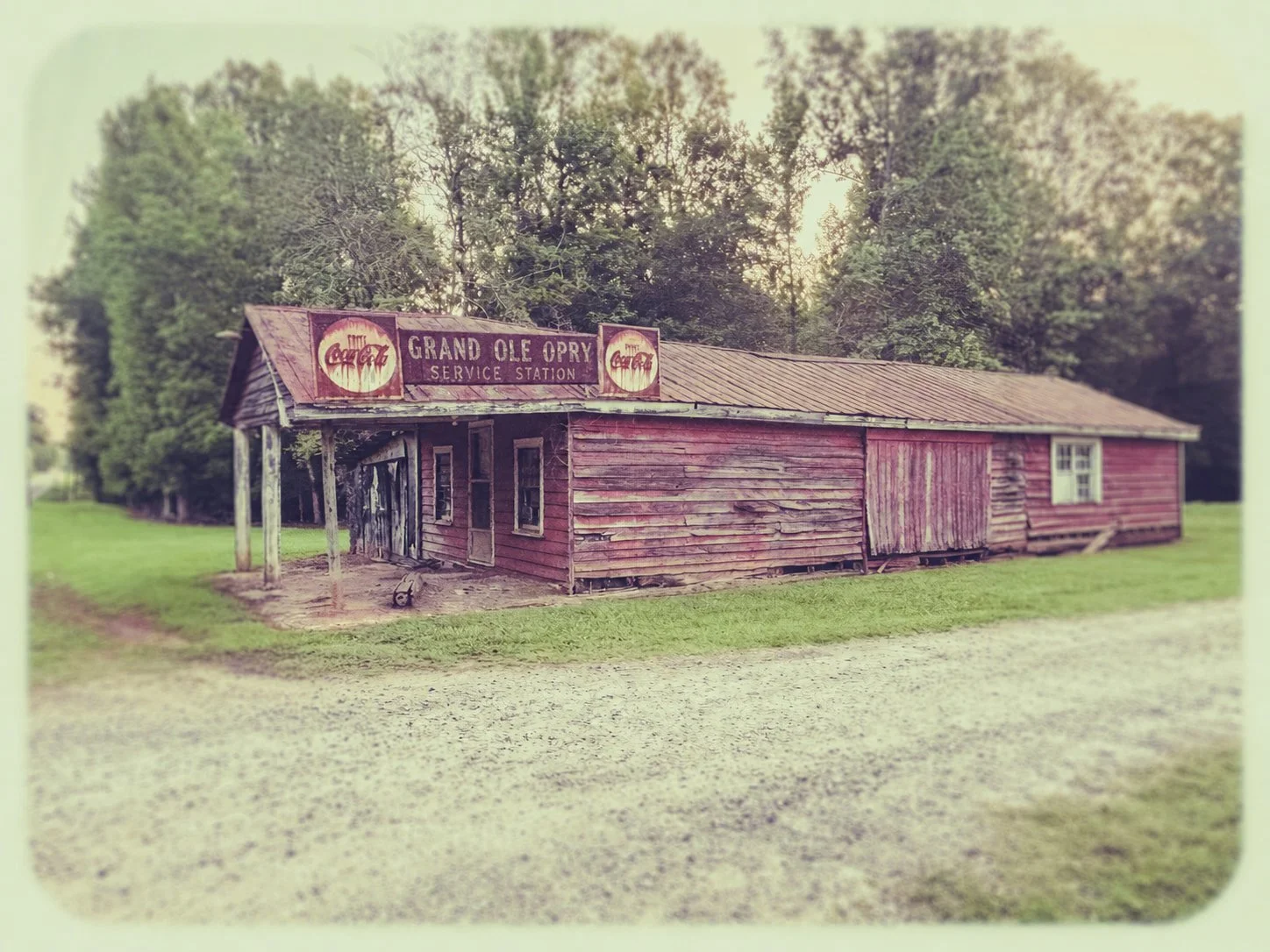
Driving along NC Highway 96 through the Oak Hill community of Granville County, I came across this weathered old building at 8028 NC-96. At first glance, it looked like an abandoned country store—an old wooden structure with peeling red paint, a rusted metal roof, and a porch that has seen better days.
But something about the sign above the front caught my eye.
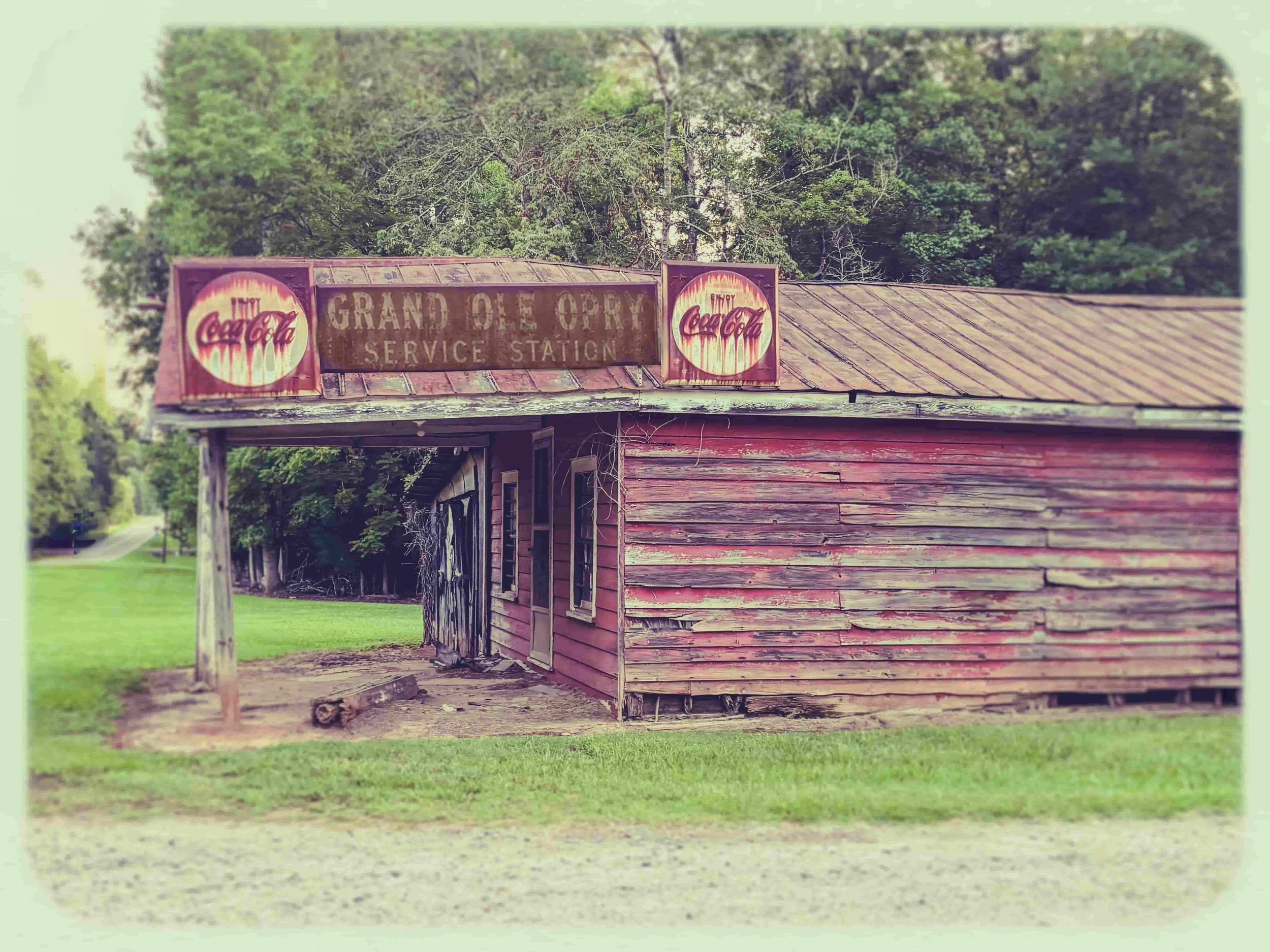
Most of the lettering had faded away, almost disappearing into the weathered wood. Fortunately, I found several older photographs of the building online from a time when the sign was still more legible. Using those photographs as a reference, I digitally enhanced the sign, bringing the faded lettering back into view and giving me a glimpse of what this old landmark once looked like.
It revealed the name:
GRAND OLE OPRY
SERVICE STATION
And suddenly, this wasn't simply an old building along a country road. It was a piece of Oak Hill's history.
A Community Built Around the Country
To understand a place like the Grand Ole Opry Service Station, it helps to understand Oak Hill in the years when this building was part of everyday life.
Oak Hill was a small rural community in northern Granville County, surrounded by family farms and agricultural land. During the middle decades of the twentieth century, tobacco was an important part of the local economy, along with crops such as corn and hay and the livestock and other activities that supported family farms.
Oxford, the county seat, was the area's larger commercial center, but communities such as Oak Hill had their own churches, schools, farms, and small businesses.
And in a rural community, a country store could be surprisingly important.
More Than Just a Service Station
Although its name suggests a gas station, buildings like this typically served many purposes.
Based on its architecture and the surviving Coca-Cola advertisements painted on the exterior, the Grand Ole Opry Service Station appears to have been both a country store and a filling station.
During its busiest years, a visitor might have found fuel and automotive supplies like gasoline, motor oil, fan belts, and spark plugs. The store likely carried everyday grocery staples such as flour, sugar, coffee, eggs, canned goods, bread, and candy, making it a convenient stop for local families. Many country stores of the era also stocked farm essentials including livestock feed, seed, tobacco twine, fence staples, and other hardware needed to keep nearby farms running.
And, of course, the painted Coca-Cola signs suggest that cold bottled soft drinks were part of the experience as well, offering a welcome refreshment after a long day in the fields or for travelers passing through.
A store like this wasn't simply a place to buy something.
It was a place to stop.
Neighbors could catch up on local news, farmers could exchange information, travelers could ask for directions, and someone heading home from Oxford could pick up a few groceries along with a tank of gas.
In a small community, a store like this could be as much a gathering place as it was a business.
So Why "Grand Ole Opry"?
That's perhaps the most intriguing question about the building.
I have not yet found a surviving newspaper advertisement or other document explaining exactly why the owner chose the name Grand Ole Opry Service Station. But the timing provides an interesting clue.
During the 1940s and 1950s, the Grand Ole Opry was enormously popular throughout the rural South. Broadcast from Nashville over WSM radio, the program brought country music into homes across the region, becoming a Saturday-night tradition for generations of listeners.
The name would have been instantly recognizable to people in a community like Oak Hill.
So while I can't say with certainty why the name was chosen, it seems possible that the station's owner borrowed it from one of the era's most recognizable radio programs—a name that would have carried an immediate connection to country music and rural life.
Historical confidence: ★★★★☆
The connection is historically plausible, but we have not yet found documentation from the station's owner confirming it.
A Building That Tells Its Own Story
The building itself provides some clues about its age and purpose.
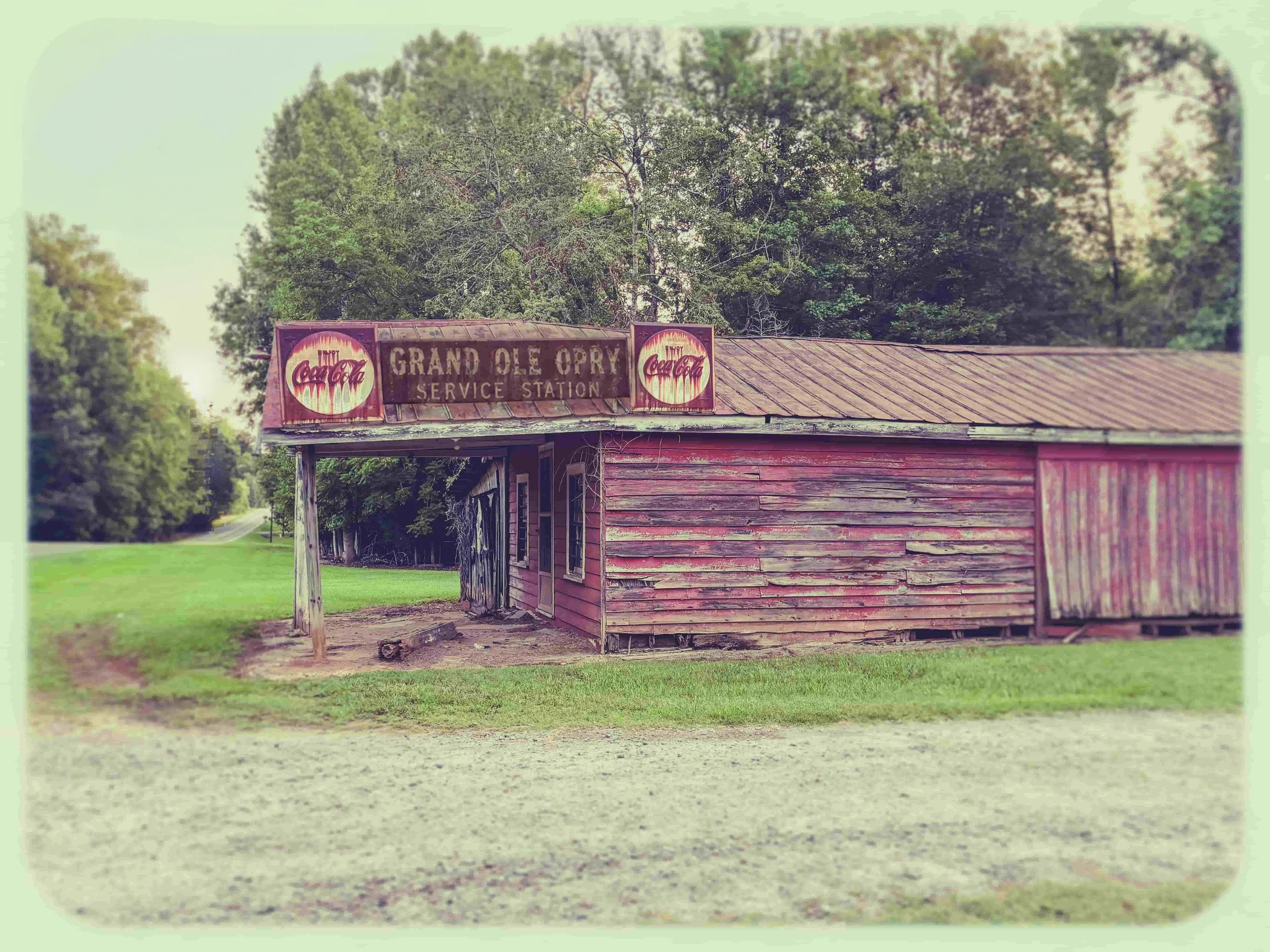
Its simple wood-frame construction, broad front porch, attached service area, and corrugated metal roof match the kind of independently built rural commercial structures common throughout North Carolina during the middle decades of the twentieth century.
Based on the construction style, surviving materials, and advertising features, I estimate that the building dates to approximately 1945–1955, although an exact construction date has not yet been established.
The Coca-Cola advertising is another fascinating detail.
Those painted advertisements weren't simply decoration. Coca-Cola's advertising program helped make the walls and signs of small-town stores part of rural America’s visual landscape. Here, some of that advertising has survived for decades beneath layers of weather and fading paint.
And then there is the sign itself.
The words GRAND OLE OPRY are barely visible today, but older photographs preserve what the building once looked like.
That's one reason I photograph places like this.
Sometimes the photograph becomes part of the history.
What Happened to the Grand Ole Opry Service Station?
That's where the historical trail becomes much harder to follow.
Small rural businesses often left surprisingly little documentation behind. Unlike large companies or prominent commercial buildings, a country store might appear in a newspaper only when someone advertised an item for sale, changed ownership, held an auction, or had some other newsworthy event.
So far, I have not been able to establish a complete ownership history for the property or identify the station’s original operator with enough certainty to publish it as fact.
The Granville County Register of Deeds contains historical property records, and further research into those records may eventually reveal the people who owned the property and operated the business.
For now, some of the story remains hidden.
And perhaps that's appropriate for a building that has already survived so much.
Oak Hill Then and Now
Imagine Oak Hill during the years when this station was busy.
The world would have been very different.
There were no convenience stores on every corner. No smartphones. No GPS. No online shopping. No supermarket a few minutes away for every forgotten item.
The family farm was still an important part of rural life, and getting in the car and heading into town took planning.
A place like the Grand Ole Opry Service Station brought some of those necessities closer to home.
You could stop for gasoline.
Pick up a few groceries.
Get something cold to drink.
Ask about a neighbor.
Hear the latest news.
Then get back on the road.
The building may have been small, but its role in the community could have been much larger than its size suggests.
A Small Piece of a Disappearing North Carolina
Today, the Grand Ole Opry Service Station sits quietly beside the road.
The gasoline pumps are gone. The business is gone. The sign has nearly disappeared. Much of the building has weathered to the point where nature seems determined to reclaim it.
But the structure remains.
And with it remains a glimpse into a time when rural communities were connected by places like this—small stores, filling stations, churches, and crossroads where people knew one another and everyday life unfolded at a slower pace.
We often preserve the big things in history: courthouses, historic homes, battlefields and grand buildings.
But history also lives in places like this.
A little country store.
A weathered Coca-Cola sign.
A faded name inspired by a Saturday-night radio broadcast.
And the memories of the people who once stopped here.
Help Preserve This History
The history of many rural landmarks survives only through the memories of the people who knew them.
If you have photographs, newspaper clippings, family stories, or memories of the Grand Ole Opry Service Station or the Oak Hill community, I would love to hear from you.
Who owned it?
Who worked there?
What did it sell?
Did you stop there for gasoline or a cold Coca-Cola?
And most importantly—what do you remember?
Every photograph and every story can help preserve another small piece of North Carolina's rural heritage.
Historical Notes
Location: 8028 NC Highway 96, Oak Hill, Granville County, North Carolina
Historic Name: Grand Ole Opry Service Station
Building Type: Country store and service station
Estimated Construction: c. 1945–1955
Estimated Period of Operation: Mid-20th century; exact dates remain undetermined
Current Status: Building survives
Historical Confidence
Location — ★★★★★
Historic name — ★★★★★
Service station/country store use — ★★★★★
Mid-century construction — ★★★★☆
Estimated construction date — ★★★★☆
Origin of the "Grand Ole Opry" name — ★★★★☆
Exact operating dates — ★★★☆☆
Original owner/operator — ★☆☆☆☆
This history is based on available property information, historic photographs, architectural evidence, local historical context, and period research. Some details remain unconfirmed and may be updated as additional historical records or firsthand accounts are discovered.