A Photographer’s Guide to Sunrise, Night Skies, and Coastal Light
Please note: Some links on this page are affiliate links (including B&H and Adorama). This means I may earn a small commission if you purchase through those links—at no additional cost to you.
There is something magical about the drive down NC Highway 12 from Nags Head to the Bodie Island Lighthouse in the dark.
A lone stretch of highway reduced to headlights and the faint twinkle of the lighthouse in the distance.
For a moment, it disappears, swallowed again by the night, and I wonder if I imagined it or have already driven past—only to be reassured again as this guardian of the coast signals its presence through its distinct 30-second light cycle:
2.5 seconds on
2.5 seconds off
2.5 seconds on
22.5 seconds off
The drive is a great time for quiet self-reflection before turning onto Bodie Island Lighthouse Road. The turn is easy to miss in the dark, and on more than one occasion, I found myself so deep in thought that I missed it and had to turn around at the Bodie Island Coast Guard Station just before the Marc Basnight Bridge.
The Approach to the Lighthouse
Turning onto Bodie Island Lighthouse Road brings a new sense of anticipation about what lies ahead.
After passing the ranger station on the left, you enter a pine grove. On a dark night, it can feel reminiscent of Ichabod Crane’s ride through Sleepy Hollow.
That feeling is short-lived as the short stretch of road opens into the parking lot loop and the comforting view of the keeper’s house and lighthouse rising behind it.
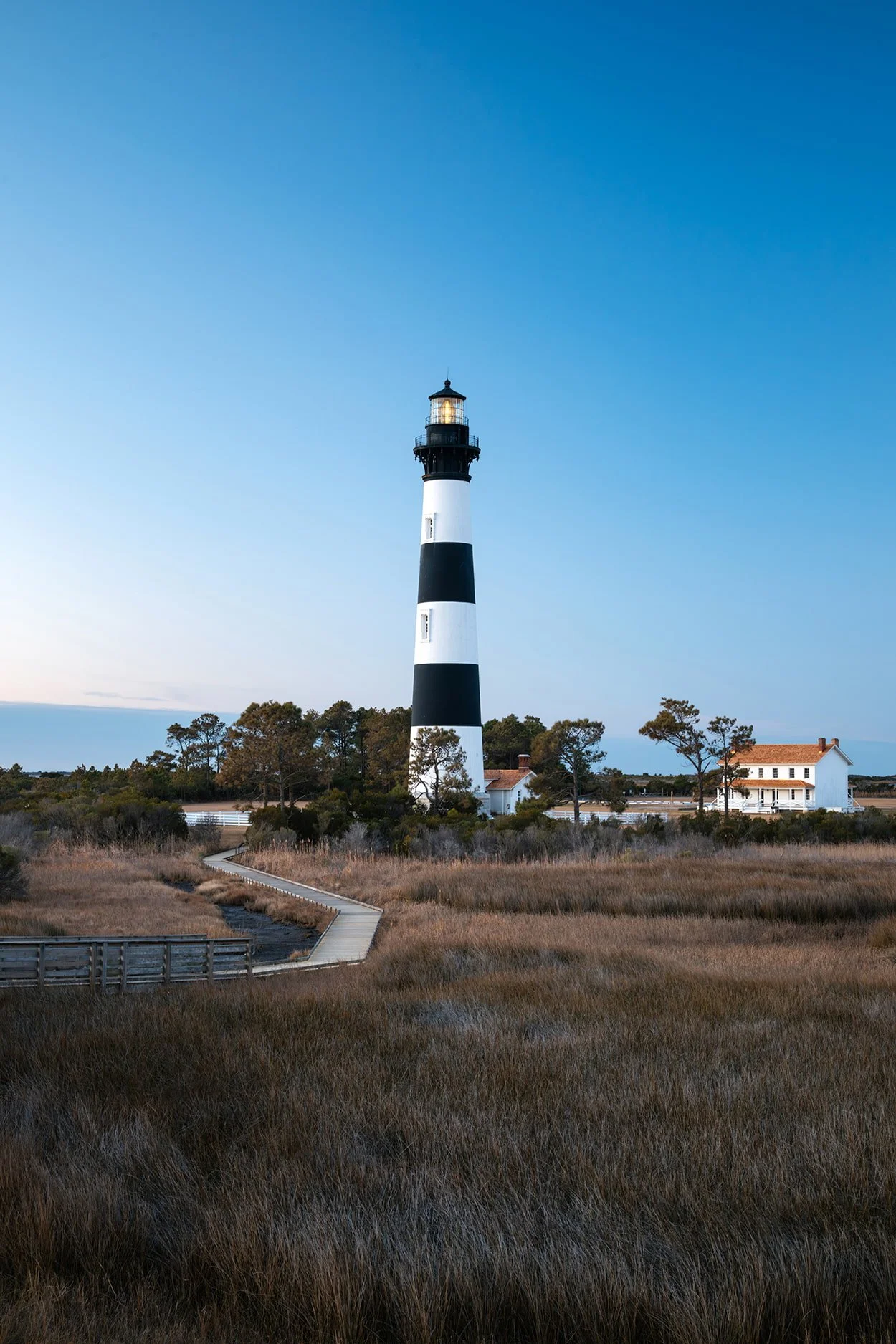
Surrounded by wetlands, wooden boardwalks, and sweeping views of the Roanoke Sound, its iconic silhouette reveals itself even on the darkest of nights.
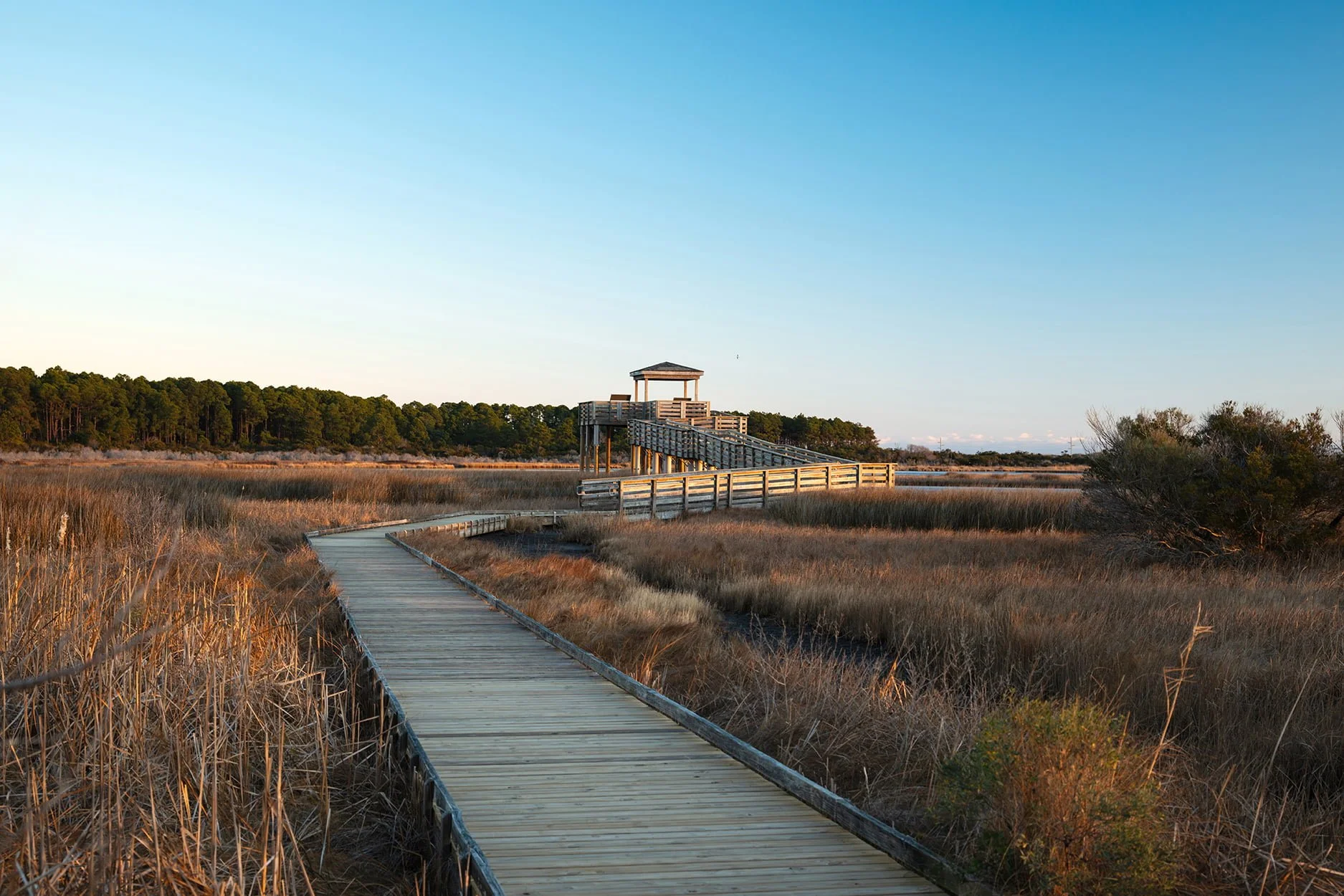
My Favorite Sunrise Spot: The Birdwatch Tower
My favorite place to enjoy the morning’s dawn is, without a doubt, the birdwatch tower.
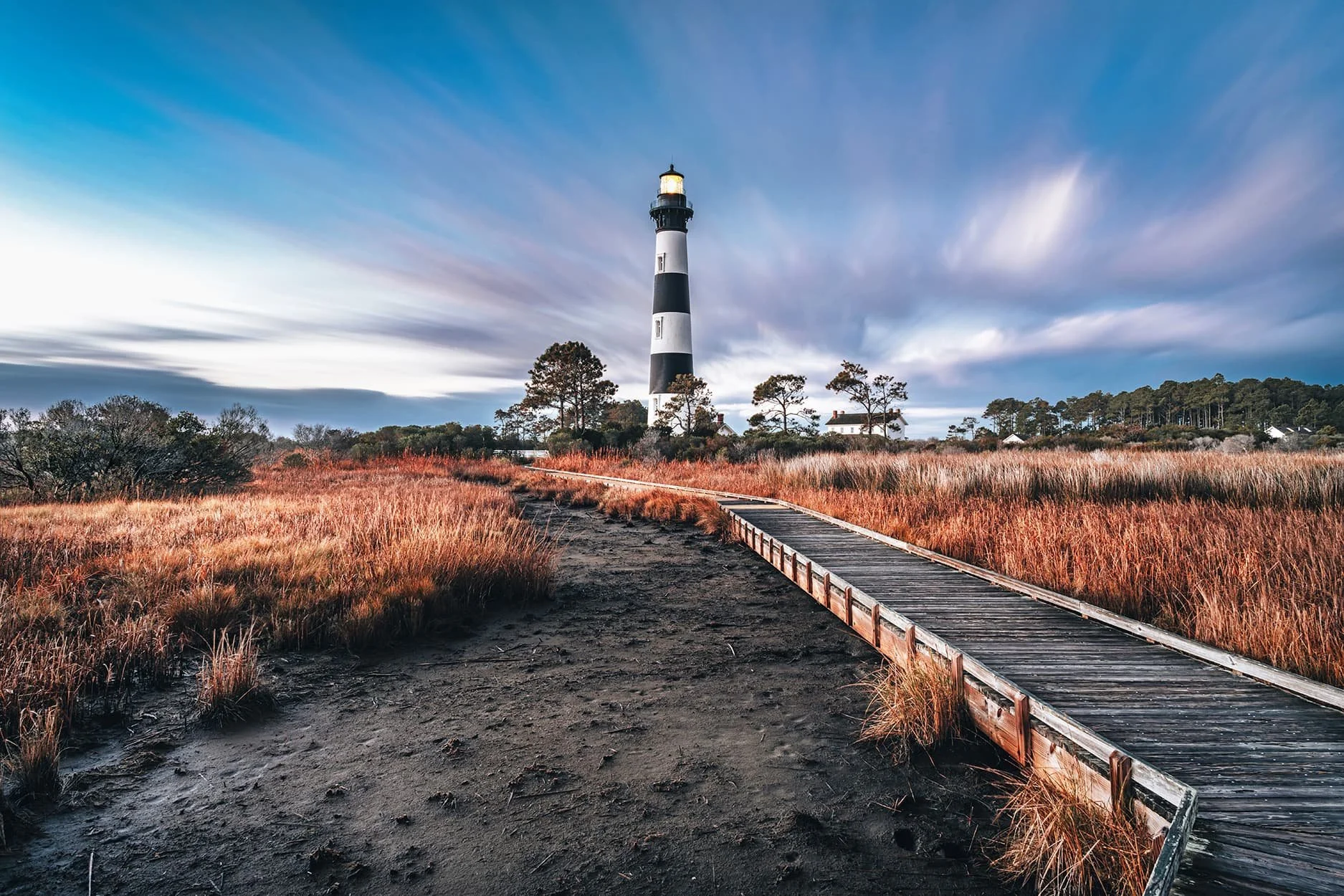
It’s a short walk from the parking lot along a wooden boardwalk, with the silent sentinel at your back before veering left across the tidal pools of the marsh.
With my red headlamp leading the way, the serene silence gives way to the familiar thump and creak of footsteps on the boardwalk and the occasional echo of a coastal bird calling in the distance.
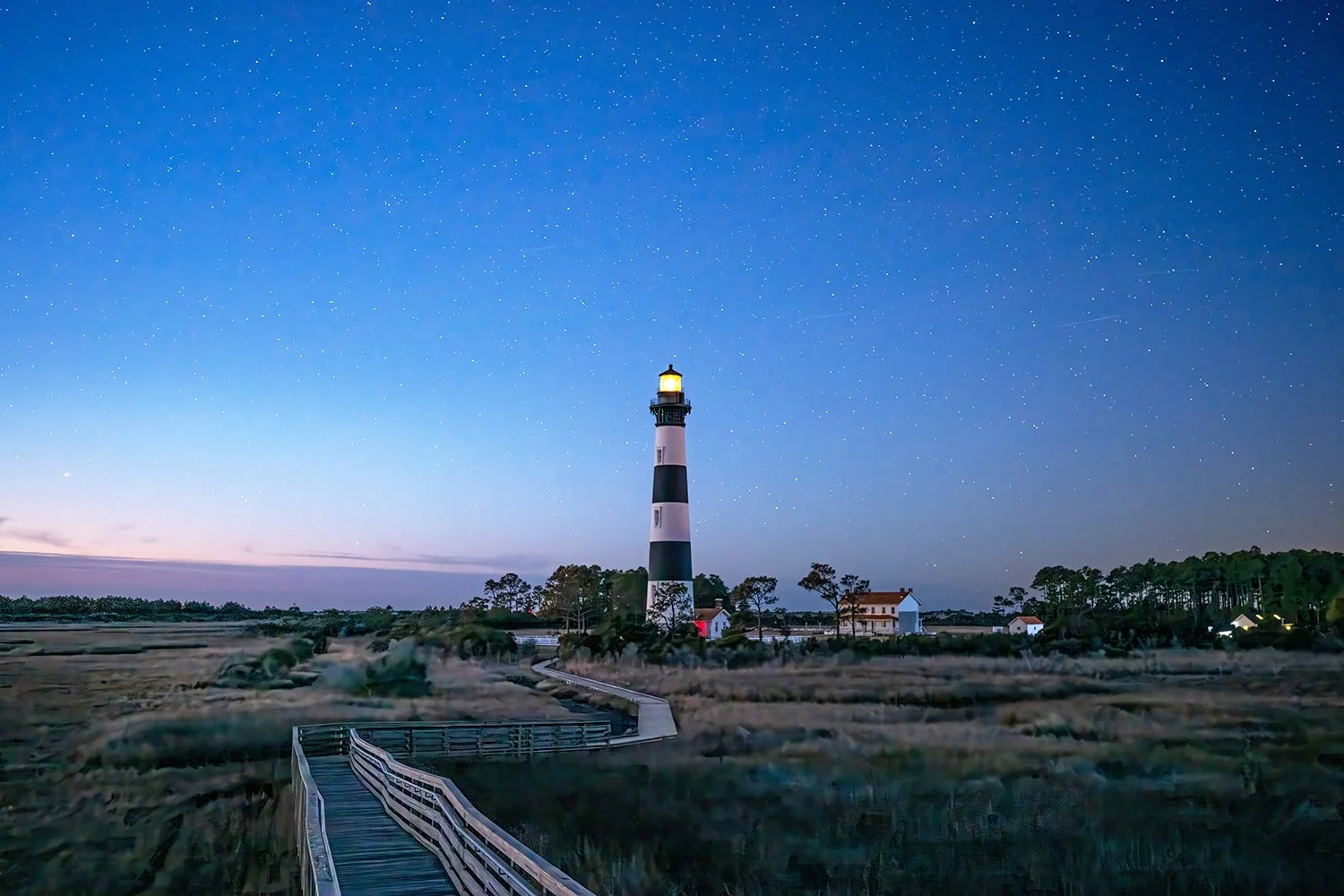
I always enjoy arriving about an hour before first light. This offers a great opportunity for astrophotography as the night loosens its grip. On clear nights, the sky transforms from a dark canvas into a deep blue gradient along the horizon, leaving only the brightest stars dotting the sky.
Night Photography at Bodie Island Lighthouse
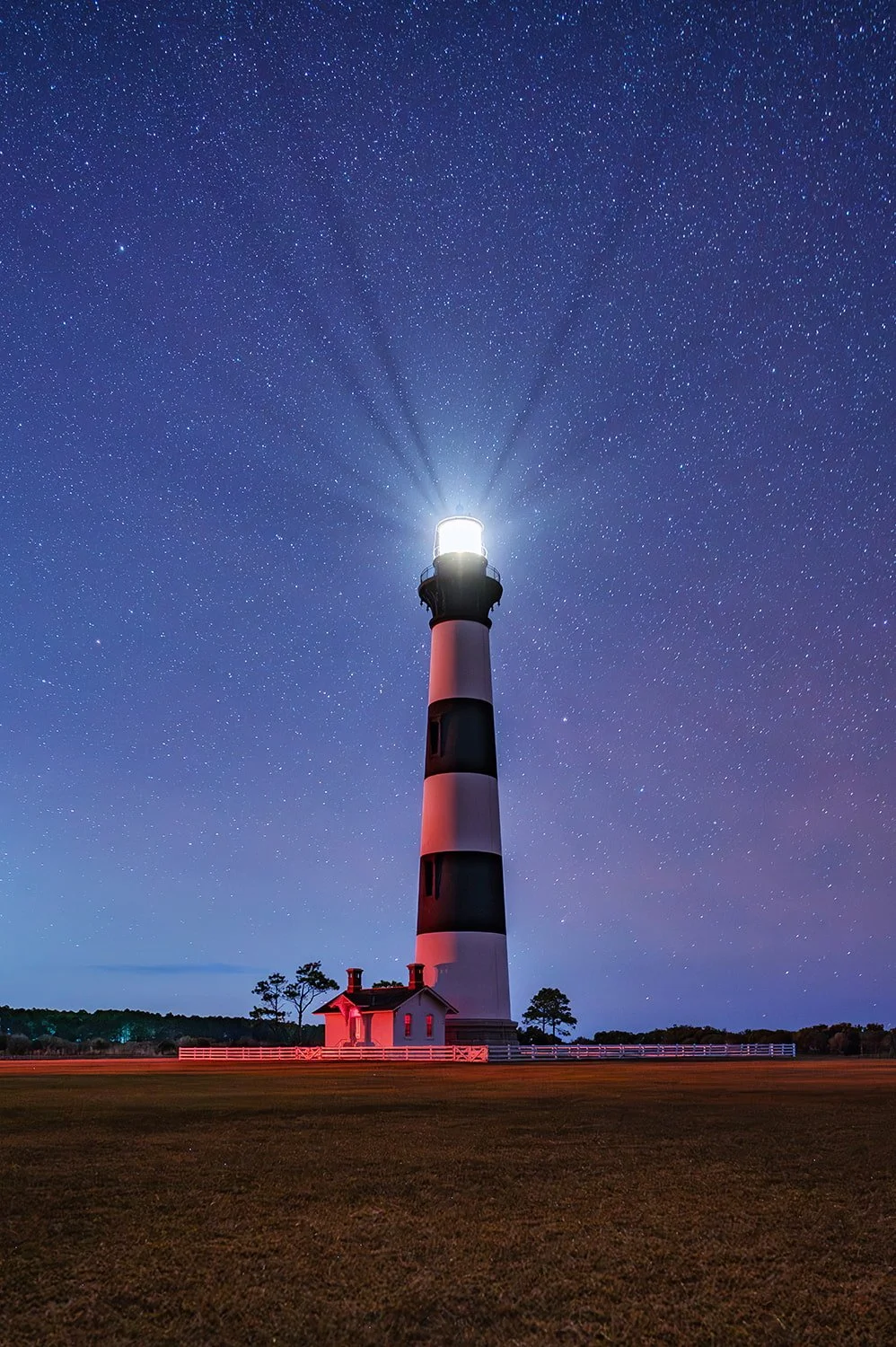
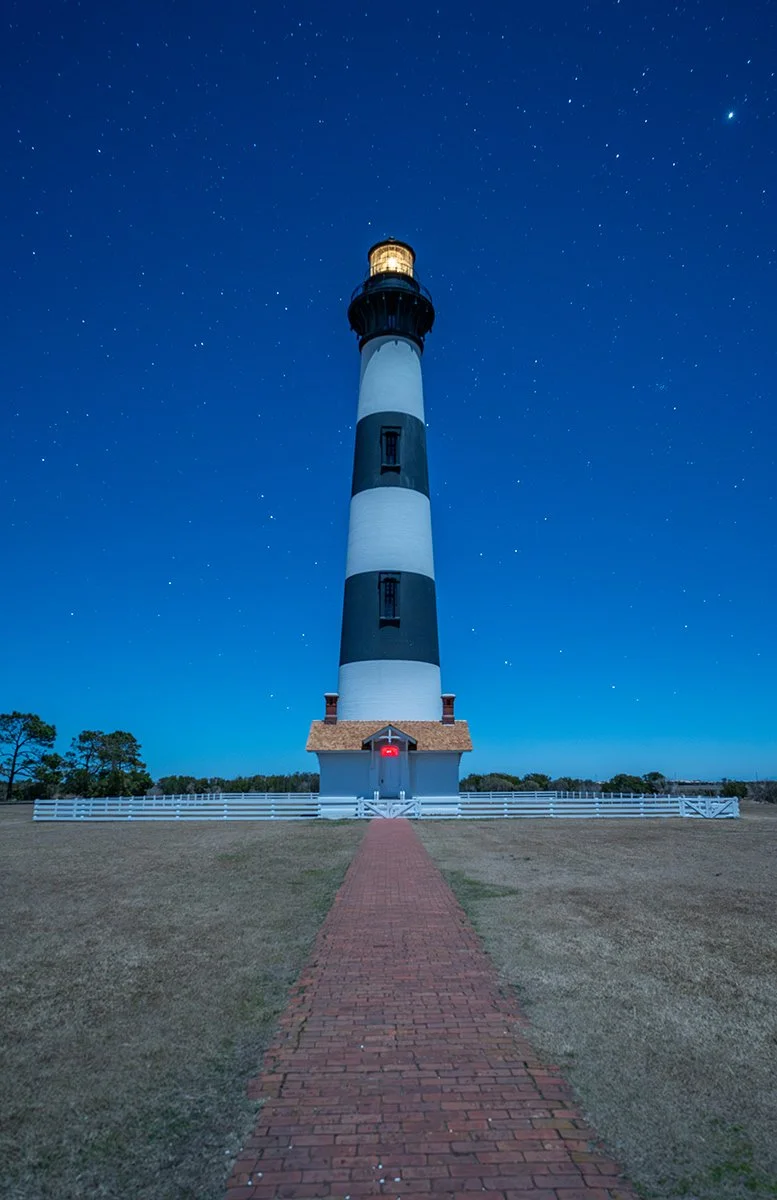
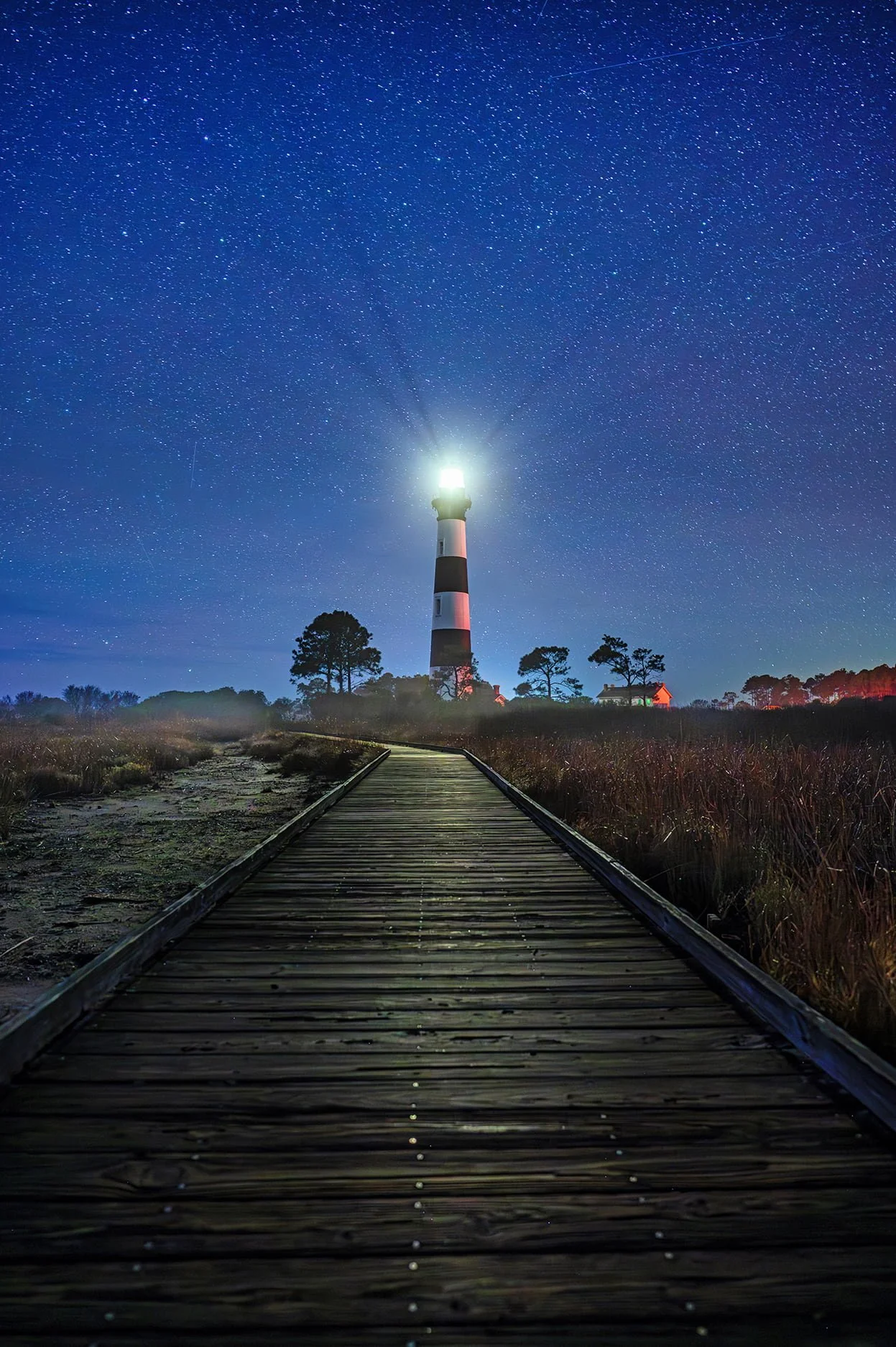
Photographing Bodie Island at night can be both rewarding and challenging.
There are a few gear requirements—especially when it comes to lenses. A wide-angle lens in the 14–24mm range with a fast aperture (f/2.8 or faster, ideally f/1.4–f/1.8) is essential for gathering light and keeping ISO noise under control. My preferred setup is the Nikon Z6II paired with the Nikon Z 20mm f/1.8.
A headlamp with a red light is just as important. Preserving your night vision makes a huge difference, and red light allows you to see without completely resetting your eyes. You’ll want something bright enough for navigating the boardwalk, but simple enough to avoid accidentally blinding yourself with white light. It takes about 30 minutes for your eyes to fully adjust to the dark—use that time to find your composition, get your tripod set, and roughly frame your shot.
Focusing at night is often the biggest challenge—and it’s all manual. Use live view on the back of your camera to dial things in. One of the biggest misconceptions with astrophotography is that you can just set your lens to infinity and call it good. In reality, the goal is more precise. Start by focusing on the lighthouse, then slowly adjust the focus ring until the brightest star in your frame becomes the smallest, sharpest point possible. It takes some practice, but once it clicks, it becomes second nature.
Exposure time is another key factor. To keep stars as sharp points and avoid trails, use the “500 Rule”—divide 500 by your focal length (for example, 500 ÷ 24mm ≈ 21 seconds). With newer high-resolution sensors, a more conservative 300 or 400 rule often produces better results, requiring slightly shorter exposures to maintain sharpness.
Experiencing Daybreak at Bodie Island
Experiencing daybreak here can be incredibly soul-rejuvenating.
Spending time with this living historical landmark provides a peaceful sense of escape and solitude. Its stoic outline offers a steady presence in a chaotic life.
Its beaming light stirs up stories of lonely lighthouse keepers and the romance of maritime exploration.
The expansive views from the birdwatch tower are perfect for a zoom lens like my trusty Nikon Z 24-120mm f/4. This versatile lens offers numerous framing compositions and even works well for astro shots as first light approaches.
The boardwalk leading toward the lighthouse can also serve as a strong leading line in many compositions.
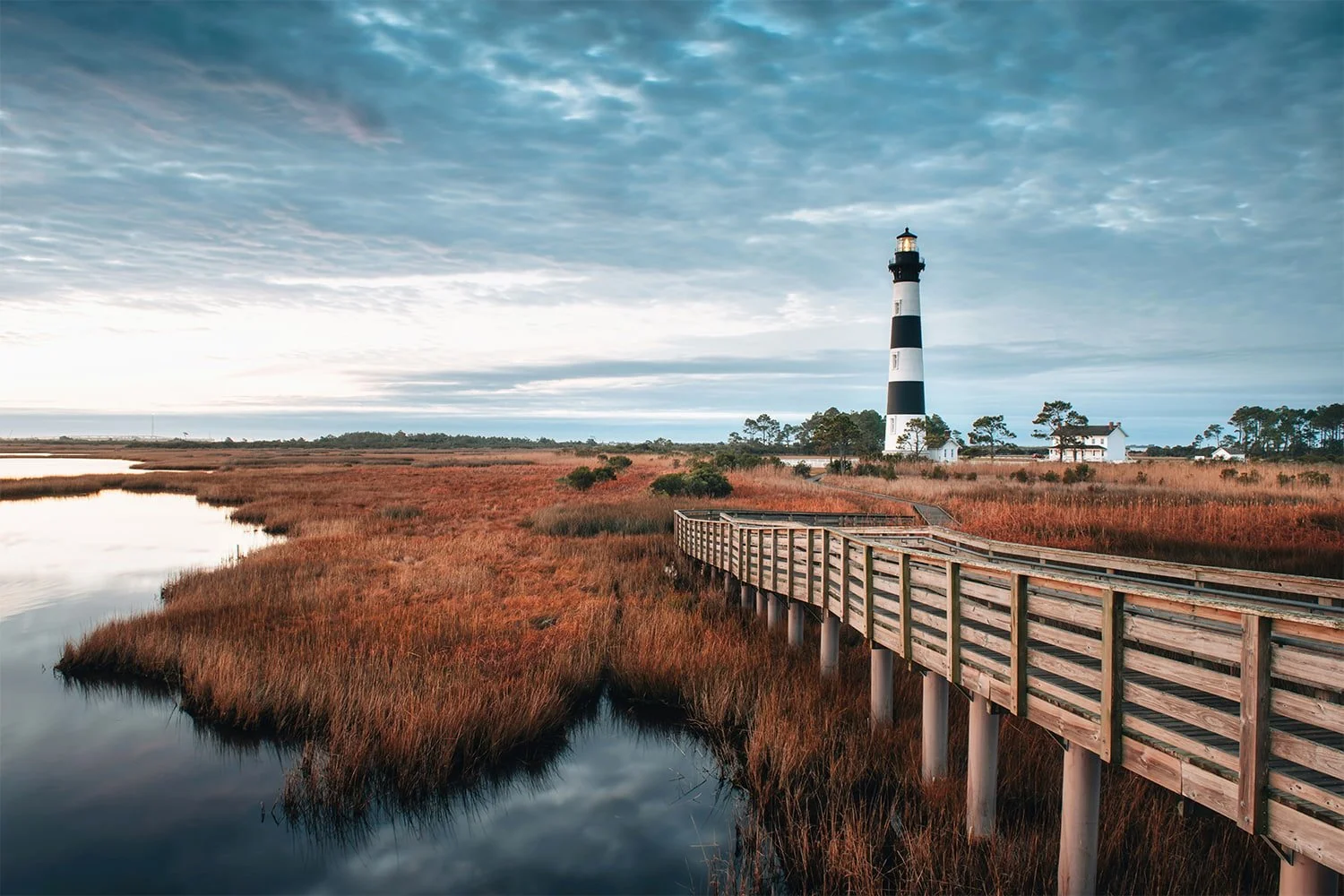
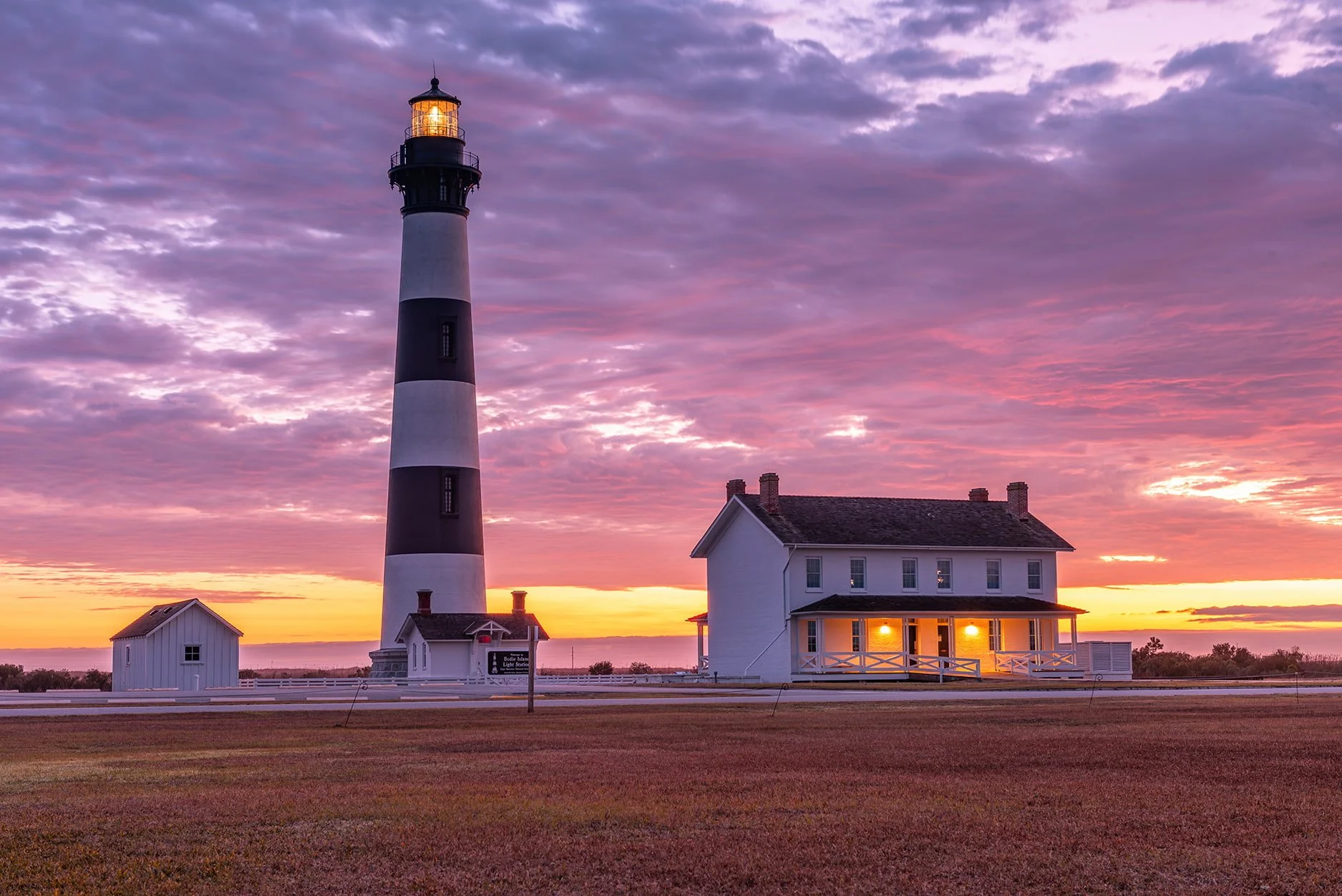
The sun rises to the left when viewed from the birdwatch tower, slowly revealing the lighthouse’s distinctive black-and-white horizontal stripes.
One of the joys of photography here is the anticipation and quiet tension in the air as you wait for the sky to reveal its morning secrets. While forecast apps can provide probabilities, you never truly know what the universe has in store.
I’ve experienced:
Brilliant palettes of orange and purple
Pastel pink and blue skies
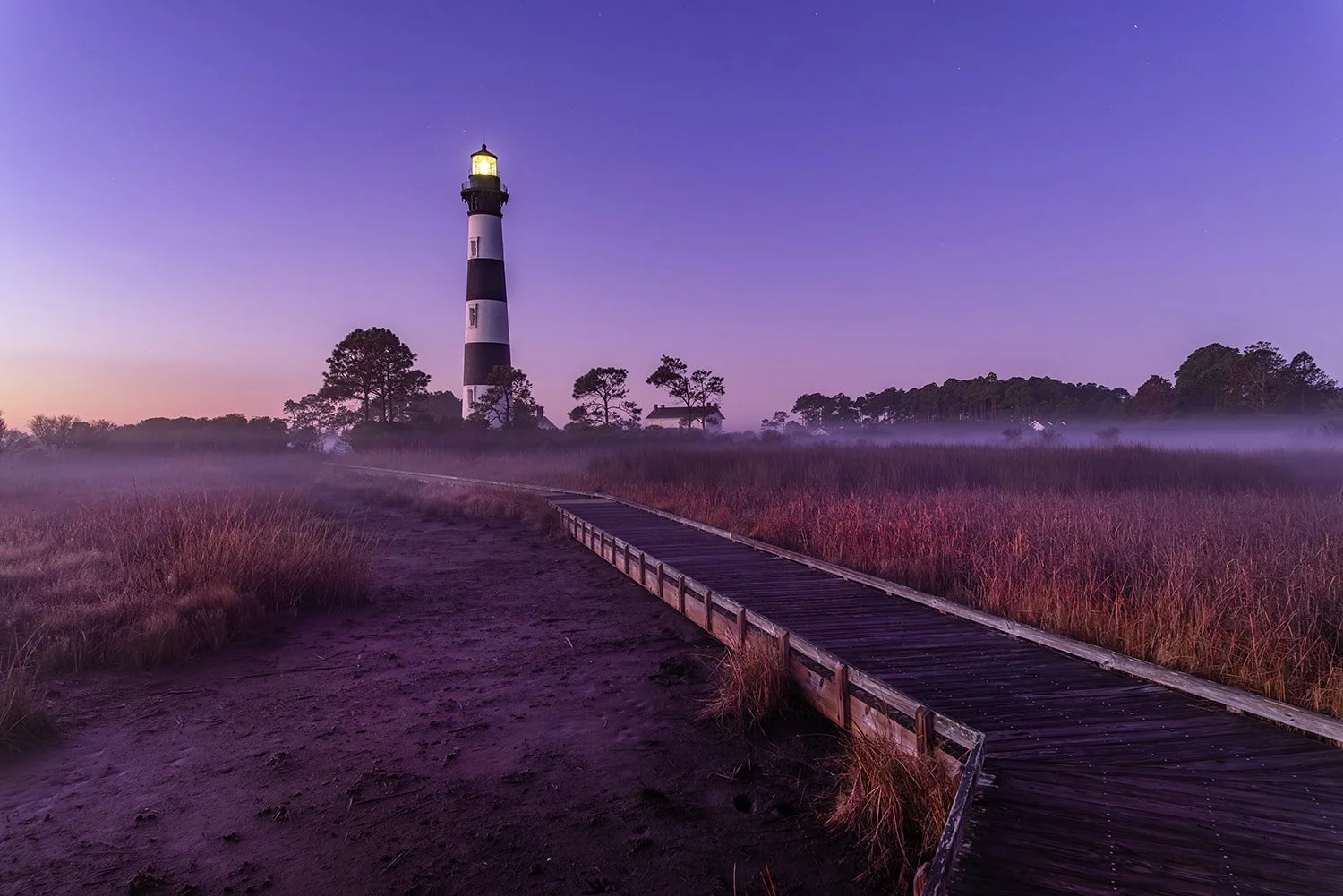
Fog-shrouded mornings
Some of the purest natural light I have ever seen
Bodie Island Lighthouse Facts
Here are some foundational facts about this timeless landmark:
Bodie Island is pronounced “body.”
The lighthouse stands 156 feet tall with 214 steps to the top.
Built in 1872, this is the third lighthouse on the site.
Earlier versions were constructed in 1848 and 1859.
The lighthouse is part of the Cape Hatteras National Seashore and is managed by the National Park Service.
It features a distinctive daymark pattern of horizontal black-and-white stripes.
It uses a Fresnel lens, resembling a giant beehive made of multi-faceted glass prisms mounted in a brass framework.
The beam can be spotted by sailors up to 20 miles offshore.
Photography Gear I Use at Bodie Island Lighthouse
One of the most photographed landmarks in the Outer Banks deserves reliable gear. Here is what I typically bring:
Camera Bodies
Lenses
Tripod Setup
Classic Photography Locations at Bodie Island Lighthouse
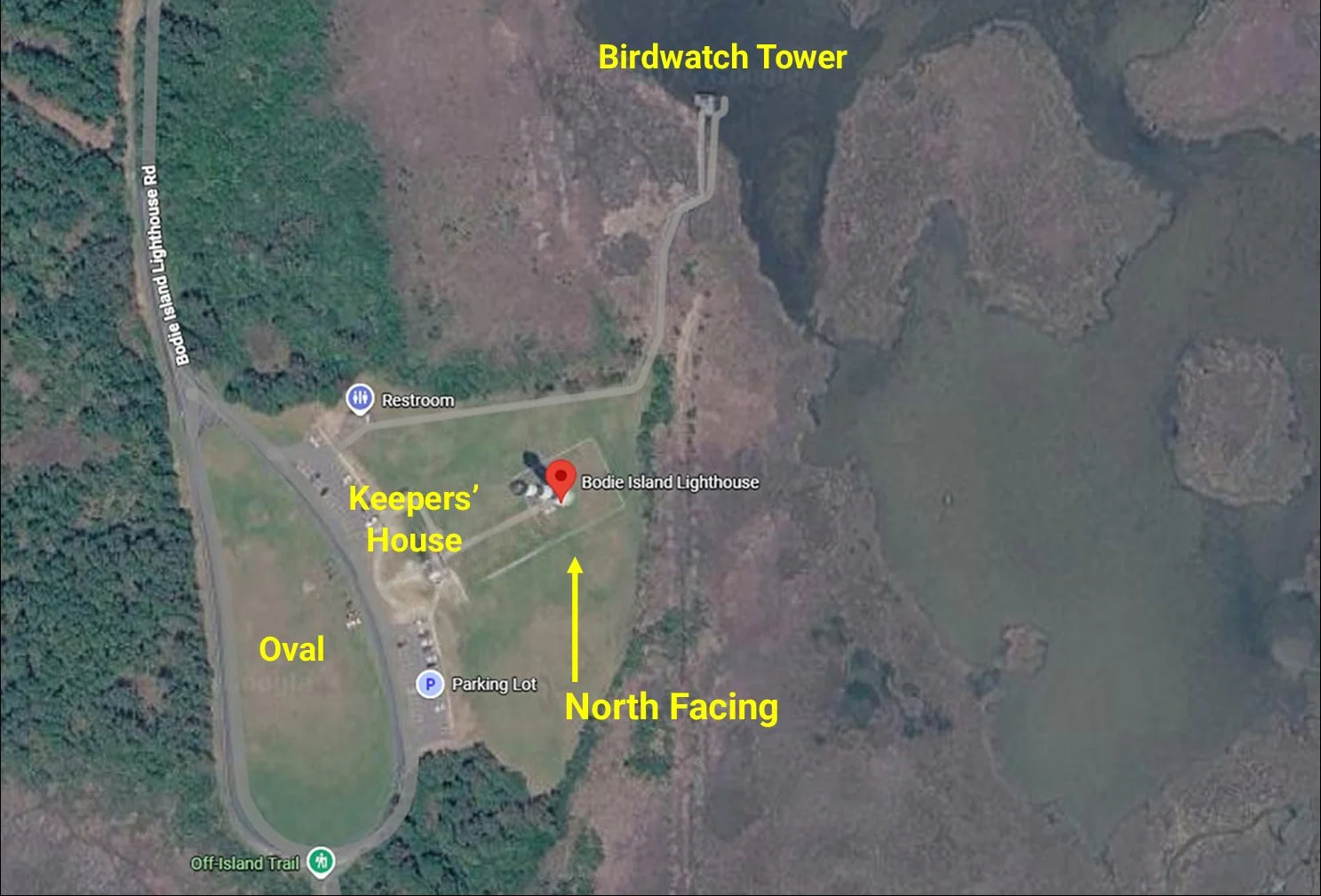
Besides the birdwatch tower, there are three other excellent photography locations.
1. The Keeper’s House Back Porch
The back porch of the double keeper’s house offers a classic composition. This is not always an easy shot to pull off. A wide-angle lens (14–30mm or 14–24mm) is ideal here, though I’m often happy with what my 24–120mm produces at 24mm. Because you are standing so close to the lighthouse, lens distortion becomes part of the composition—something I don’t mind.
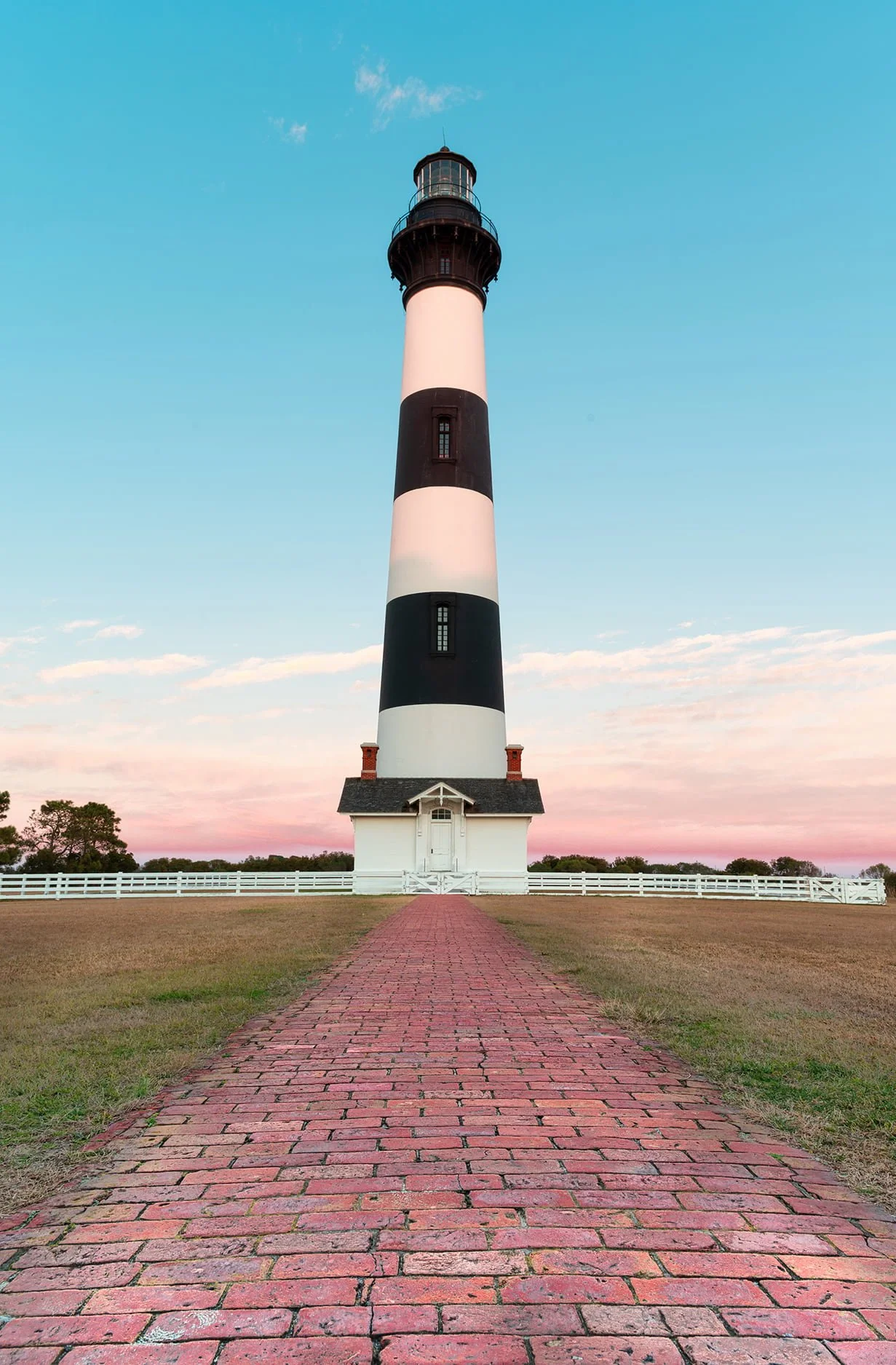
Getting low to the ground with the morning light can reveal beautiful texture in the brick sidewalk leading from the keeper’s house to the lighthouse. I also enjoy being here at night when no one else is around. In the quiet isolation, shadows around the keeper’s house seem to shift from time to time. It can almost feel as if someone is resting inside, watching over the grounds. The presence of a keeper lingering just beyond the window glass. It’s not threatening—just strangely comforting. Like the past pressing against the present. As if the keeper’s attention never truly left, continuing to watch over the lighthouse…and me.
2. The North Field
Facing north is another classic composition.
This shot works best with:
Dramatic skies
A colorful sunset
Storm clouds rolling through.
Without those elements, the composition can feel fairly ordinary. The large grassy field offers plenty of space to experiment with different angles, and it is also the ideal location to photograph star trails around the North Star at night.
3. The Oval Reflection Spot
The oval is the grassy area that the entrance road circles before reaching the parking lot. If visiting at night, be careful. Just a few steps from the parking lot, there is a low rope barrier designed to keep vehicles off the grass. It can be a trip hazard in the dark if you’re fumbling with camera gear while walking toward the oval.
After heavy or sustained rain, this area can fill with a sheet of water that creates a mirror reflection of the keeper’s house and lighthouse. With the right lighting, this can produce a true “wall hanger.” That’s Southern slang for something worthy of hanging on the wall—usually reserved for a fisherman’s dream catch. The elusive oval reflection has become my personal nemesis.
I’ve chased that classic reflection shot for years. Every visit, I arrive with a camera and anticipation, only to find the water nowhere to be found. But that’s one of the things I love about photography. There is always another image waiting to be captured. And one day, when the conditions finally line up, that reflection will be magical.
7 Photography Tips for Visiting Bodie Island Lighthouse
If you’re planning to photograph Bodie Island Lighthouse, these tips will help.
1. Arrive Early or Stay Late
Sunrise and sunset offer the softest light and the fewest people. Golden hour here is pure magic.
2. Scout Angles During the Day
Walk the perimeter and boardwalks to find unique perspectives using the marsh, water, and lighthouse.
3. Visit After a Storm
Fast-moving clouds after storms can create dramatic skies that make images far more compelling.
4. Bring a Tripod
A tripod is essential for long exposures at sunrise, sunset, and night.
5. Pack a Lens Cloth
Coastal spray and mist can quickly fog lenses. A microfiber cloth is essential.
6. Don’t Forget the Details
Look for foreground elements like marsh grasses, boardwalks, birds, and tree limbs to add character.
7. Dress for the Season
Winter can make you feel like a human popsicle, while spring and summer bring biting flies. Layers and bug spray will save your sanity.
Visit Bodie Island Lighthouse
Don’t miss this beacon of the Outer Banks. Ever-changing coastal light creates endless photographic possibilities. This keeper of the night stands alone as the world moves around it.
Address
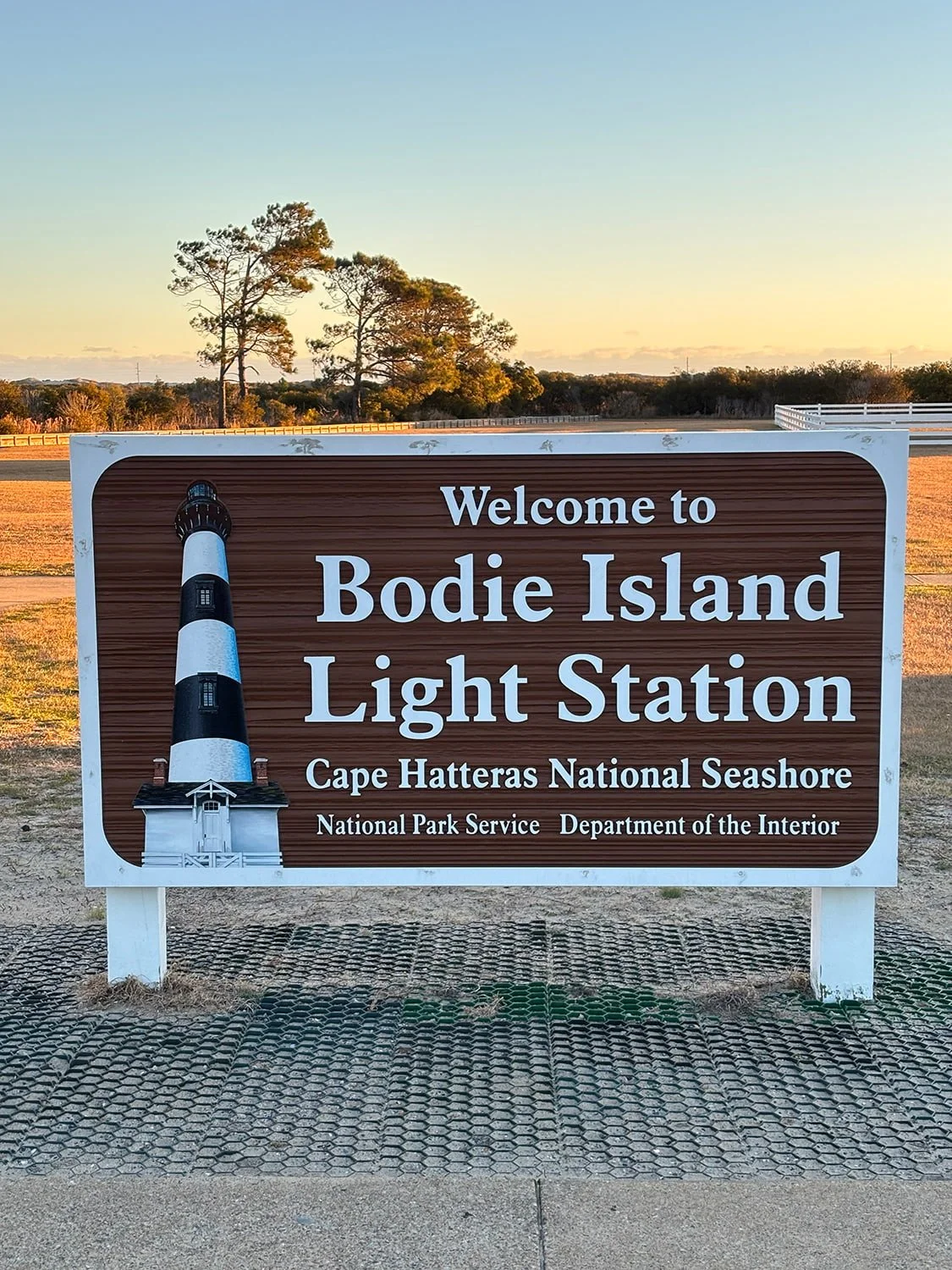
Bodie Island Light Station
8210 Bodie Island Lighthouse Road
Nags Head, North Carolina 27959
Official Information
National Park Service:
https://www.nps.gov/caha/planyourvisit/bils.htm